
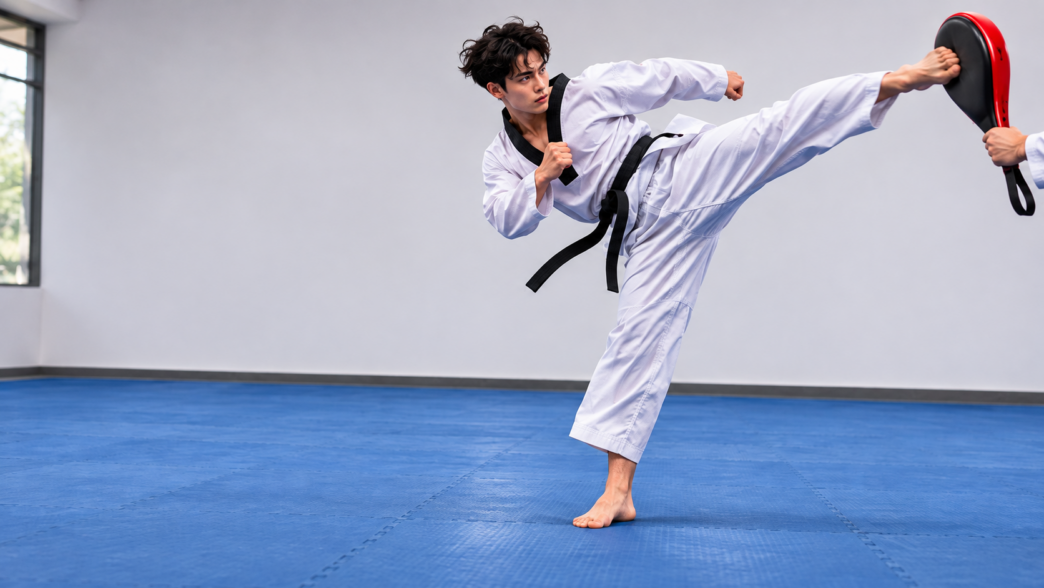
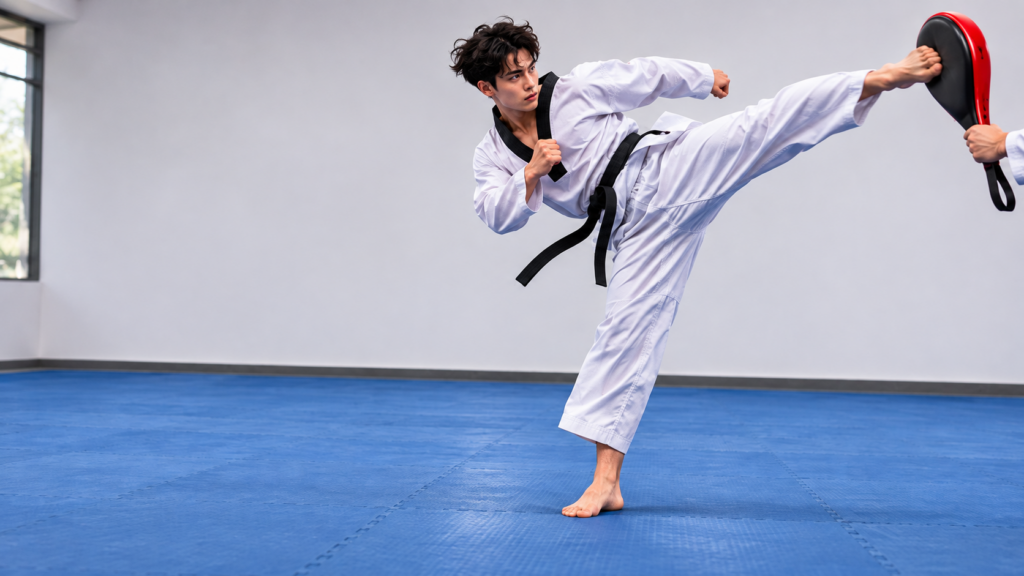
Taekwondo spinning kicks turn your back to the target for a split second, then use that rotation to drive the kick. The three most taught are the back kick (dwi chagi), the spinning hook kick (dwi huryeo chagi) and the tornado kick. They hit harder than most front-leg kicks and score extra points in World Taekwondo sparring, but they also need good balance, a clean pivot and solid basic kicks first. This guide covers each kick step by step, the mistakes to fix, the drills to use and how they score.
| The three kicks | Back kick (dwi chagi, 뒤차기), spinning hook kick (dwi huryeo chagi, 뒤후려차기), tornado kick |
|---|---|
| What they share | A body turn that puts your back to the target before the kick lands |
| Learn first | Front, roundhouse, side and hook kicks, plus a steady pivot on the ball of the foot |
| Easiest to hardest | Back kick, then spinning hook kick, then tornado kick |
| Main striking surface | Heel for the back kick and spinning hook; instep or ball of the foot for the tornado kick |
| Sparring value (World Taekwondo) | Turning kicks score double: 4 points to the trunk protector, 6 to the head |
Basics
What makes a kick a spinning kick
A spinning kick, also called a turning kick in World Taekwondo rules, is any kick where your body rotates away from the target before the kick lands. For a moment you face away from your opponent, then the hips and shoulders unwind and carry the leg into the target.
That rotation does two things. It adds power, because the whole body turns behind the kick. It also hides the kick, because your opponent sees your back instead of a chambered leg.
The cost is risk. While you turn, you can lose sight of your opponent, lose your balance or get countered. That is why instructors teach spinning kicks after the basic kicks, usually from colored-belt ranks onward. For the full list of kicks and where these fit, see taekwondo kicks: a complete list.
Before you start
Prerequisites: kicks to learn first
Each spinning kick borrows the mechanics of a basic kick. If the basic kick is weak, the spinning version will be weaker.
- Front kick. Teaches the chamber, the recoil and balance on one leg (see how to do a front kick).
- Side kick. The back kick uses almost the same chamber and the same heel strike, just thrown backward (see how to do a side kick).
- Roundhouse kick. The tornado kick ends in a roundhouse, so you need a fast, accurate one on both legs (see how to do a roundhouse kick).
- Hook kick (huryeo chagi). The spinning hook kick is a hook kick with a turn in front of it.
- A clean pivot. You should be able to turn 180 degrees on the ball of your lead foot and stop facing the right way, without hopping or stumbling.
If you are still working on those, start with the basic taekwondo kicks first.
Kick 1
Back kick (dwi chagi)
The back kick is the first spinning kick most students learn. You turn your back to the target, look over your shoulder, and thrust your heel straight back into the target. It travels in a straight line, which makes it accurate and very powerful. It is a common counter when an opponent rushes in.
How to do a back kick, step by step
These steps start from a stance with the left foot forward. Reverse them for the other side.
- Start with your guard up. Stand side-on with the left foot forward, hands up to protect your face.
- Pivot on the front foot. Turn clockwise on the ball of your left foot so your back faces the target. Keep the turn tight; don’t step wide.
- Look over your right shoulder. Turn your head first and find the target before the leg leaves the floor.
- Chamber close to the standing leg. Lift the right knee so it passes close to the left knee, with the foot flexed and the toes pointing down.
- Thrust the heel straight back. Drive the heel in a straight line to the target. Your hips, the kicking leg and the target should line up.
- Recoil. Pull the leg back to the chamber right away.
- Land and reset. Set the foot down forward or back into a stance, and bring your eyes and guard back to the front.
Common back kick mistakes
- Turning too far. If your hips open past the target, the kick swings out in an arc like a sloppy side kick. Stop the turn when your back faces the target.
- Kicking blind. Throwing the kick before you see the target is the most common miss. Head first, then leg.
- Leading with the toes. Toes pointing to the side or up turn the strike into a push with the sole. Toes point down, heel leads.
- A wide chamber. If the knee swings out from the body, the kick loops. Brush the kicking knee past the standing knee.
- Dropping the hands. Keep the guard up through the turn.
Tip
If your back kick keeps drifting, practice it next to a wall. Stand with your back to the wall about a leg’s length away and kick the wall slowly with your heel. A straight path lands flat; a looping kick scrapes along the wall.
Kick 2
Spinning hook kick (dwi huryeo chagi)
The spinning hook kick, also called the spin hook, back hook or reverse turning kick, turns like a back kick but finishes with a hooking motion. The leg extends just past the target, then the knee bends and the heel whips back across it. It is usually aimed at the head, which makes it one of the highest-scoring kicks in sparring and one of the hardest to control.
How to do a spinning hook kick, step by step
Again, these steps start with the left foot forward.
- Start with your guard up in a side-on stance, left foot forward.
- Pivot and look. Turn clockwise on the ball of the left foot and look over your right shoulder, the same as a back kick.
- Lift and extend the leg. Bring the right knee up and extend the leg as if throwing a side kick, aimed slightly past the target toward its far side.
- Hook through the target. As the rotation continues, bend the knee and pull the heel back across the target. The strike lands with the back or bottom of the heel.
- Keep turning to finish. Let the rotation carry the leg through, then bring the knee back in.
- Land under control. Set the foot down, finish facing your opponent and get your guard back up.
Common spinning hook kick mistakes
- No extension before the hook. If the leg never straightens, the kick has no reach and no snap.
- Spinning out. Too much rotation with no control can leave you off balance or facing the wrong way. Bend the standing knee slightly and stop the spin with your core.
- Leaning far forward. Dropping the head and chest toward the floor costs height and balance.
- Not looking. As with the back kick, find the target over your shoulder before the leg comes around.
- Too much contact in practice. A full-power spin hook to an unprotected head is dangerous. Use pads or targets and light contact with partners.
Safety
This is general information, not medical advice. Spinning hook kicks put a lot of twisting load on the knee of the standing leg and the hamstrings of the kicking leg. Warm up fully, keep the standing knee soft, and build height slowly (see taekwondo stretching and flexibility). Stop and see a doctor if knee or hip pain doesn’t go away.
Kick 3
Tornado kick
The tornado kick is a jumping, spinning roundhouse kick. You turn your back to the target, jump, keep rotating in the air and land a roundhouse kick with the leg you jumped off. Many schools call it a 360 kick because the body turns a full circle. It is common in demonstrations and board breaking, and fast versions show up in sparring.
Korean names for the tornado kick vary from school to school, so ask your instructor what your school calls it.
How to do a tornado kick, step by step
These steps start with the left foot forward. The kick lands with the left leg.
- Start with your guard up, left foot forward.
- Turn your back to the target. Pivot clockwise on the left foot, look over your right shoulder and let your right foot swing around behind you.
- Drive the right knee up. As the turn continues, lift the right knee hard. This knee drive lifts your body and keeps the spin going.
- Jump off the left leg. Push up from the left foot while you keep rotating. Your eyes stay on the target.
- Kick a roundhouse with the left leg. In the air, chamber the left knee and snap a roundhouse kick into the target, striking with the instep or the ball of the foot as your school teaches.
- Land on the right foot, then the left. Land softly with bent knees and come back to a stance, guard up.
Common tornado kick mistakes
- Jumping before turning. If you jump first and spin second, you run out of air time. Turn, drive the knee, then jump.
- Kicking with the wrong leg. Beginners often try to kick with the knee-drive leg. The kicking leg is the one you jump off.
- Losing the target. If your head turns late, the kick lands off target or not at all.
- Landing stiff. Straight knees on landing jar the knees and ankles. Land soft and balanced.
- Rushing the height. Learn it low and slow before trying head-height targets.
Safety
This is general information, not medical advice. Jumping spin kicks mean a twisting landing on one leg, which stresses the knees and ankles. Practice on mats, start with low kicks and few reps, and stop if you feel joint pain (see common taekwondo injuries).
Compare
Back kick vs. spinning hook kick vs. tornado kick
| Kick | Path | Striking surface | Usual target | Difficulty | Learn first |
|---|---|---|---|---|---|
| Back kick (dwi chagi) | Straight line backward | Bottom of the heel | Trunk | Intermediate | Side kick, pivot |
| Spinning hook kick (dwi huryeo chagi) | Extends past the target, then hooks back | Back or bottom of the heel | Head | Advanced | Hook kick, back kick |
| Tornado kick | Jumping full turn into a roundhouse | Instep or ball of the foot | Trunk or head | Advanced | Roundhouse kick, back kick turn, jump kicks |
Sparring
How spinning kicks score in World Taekwondo sparring
These figures are from the World Taekwondo (WT) Competition Rules & Interpretation in force as of June 1, 2026, the rules used at Olympic-style events. Under these rules, a turning kick scores double the points of the same kick without a turn:
| Technique | Points |
|---|---|
| Punch to the trunk protector | 1 |
| Kick to the trunk protector | 2 |
| Turning kick to the trunk protector | 4 |
| Kick to the head | 3 |
| Turning kick to the head | 6 |
So a spinning hook kick that lands on the head guard is worth 6 points, twice a regular head kick. A back kick to the body protector is worth 4.
The electronic scoring system (PSS) has to register the kick first. The judges then add the extra turning-kick points by hand when they see a valid turn. If the sensors don’t score the kick, the turning bonus doesn’t count either. A spin that looks good but lands too lightly scores nothing.
Rules change often, and local or club events may use older versions. Check with your coach or the event organizer before a tournament. For the rest of the rules, see taekwondo sparring and tournament rules. ITF and ATA events use their own scoring systems, which this guide does not cover.
In a match, spinning kicks work best as counters. When an opponent charges forward, a back kick meets them as they come in. A spin hook works well after a fake or a front-leg kick that draws a reaction. For combinations that set them up, see taekwondo sparring combinations.
Practice
Spinning kick drills
Do these after a full warm-up (see taekwondo warm-up exercises), and train both sides.
- Pivot drill: from your stance, turn 180 degrees on the lead foot, look over your shoulder and stop. Repeat 10 times per side. No kick yet; just a clean turn and a quick look.
- Turn and chamber: pivot, look, and lift the knee into the back kick chamber. Hold for two seconds. This builds balance at the hardest point of the kick.
- Slow back kicks on a wall or bag: 10 slow kicks per side, checking that the heel leads and the toes point down.
- Partner paddle work: a partner holds a paddle at body height for back kicks and at head height for spin hooks. Start slow and add speed only when the kick lands clean every time.
- Hook kick into spin hook: throw five front-leg hook kicks, then five spinning hook kicks, so the spinning version copies the hook you already have.
- Tornado progression: practice the turn and knee drive without jumping, then add a small hop, then the full jump with a low roundhouse to a held paddle.
- Counter drill: a partner steps in with a body kick; you answer with a back kick to a held body shield.
For more pad, bag and partner work, see taekwondo kicking drills. To speed up the turn itself, see how to kick faster.
Safety
Dizziness, knees and landing
Safety
This is general information, not medical advice. Stop spinning drills and sit down if you feel dizzy, sick or lose your balance. If dizziness keeps coming back, or you have knee, hip or ankle pain that doesn’t go away, see a doctor before you keep training.
- Dizziness. Turning your head first and fixing your eyes on the target helps you stay oriented. Keep the number of spins per set low at first and rest between sets.
- Knees. Pivot on the ball of the foot, not a flat foot, so the knee isn’t twisted against a planted foot. Keep the standing knee slightly bent.
- Landing. Land with soft knees and your weight over your feet. Practice jumping kicks on mats, not hard floors.
- Space and partners. Leave room around you, and use pads or light contact. Spinning kicks to the head should only go to protected targets.
- Balance. Most spinning kick problems are balance problems (see how to improve balance in taekwondo).
FAQ
Frequently asked questions
What is dwi chagi in taekwondo?
Dwi chagi is the Korean name for the back kick. You turn your back to the target, look over your shoulder and thrust your heel straight back into the target. It is usually the first spinning kick students learn.
What is the difference between a back kick and a spinning hook kick?
Both start with the same turn. The back kick drives the heel straight back in a line, usually to the body. The spinning hook kick (dwi huryeo chagi) extends past the target and then hooks the heel back across it, usually to the head.
Which spinning kick should I learn first?
Start with the back kick. It uses the same chamber as the side kick and travels in a straight line, so it is the easiest to control. Add the spinning hook kick after your hook kick is solid, and the tornado kick after your roundhouse and back kick are clean.
How many points is a spinning kick worth in World Taekwondo?
Under the World Taekwondo Competition Rules in force as of June 1, 2026, a valid turning kick scores 4 points to the trunk protector and 6 points to the head. The scoring sensors must register the kick, and judges add the extra turning-kick points.
Is a tornado kick the same as a 360 kick?
Many schools use the two names for the same kick: a jumping full turn that finishes with a roundhouse kick. Some schools use the names differently, so check with your instructor.
How do I stop getting dizzy when I spin?
Turn your head first and fix your eyes on the target, keep sets short and rest between them. If dizziness keeps coming back, stop and see a doctor. This is general information, not medical advice.
The short version
Learn the back kick first: pivot, look over your shoulder, chamber close and drive the heel straight back. Add the spinning hook kick once your hook kick is solid, and the tornado kick once your roundhouse and back kick turn are clean. Turn your head first on every spin, land soft, and remember that under World Taekwondo rules a turning kick scores 4 to the body and 6 to the head. Review the Korean names in the taekwondo terminology guide.