
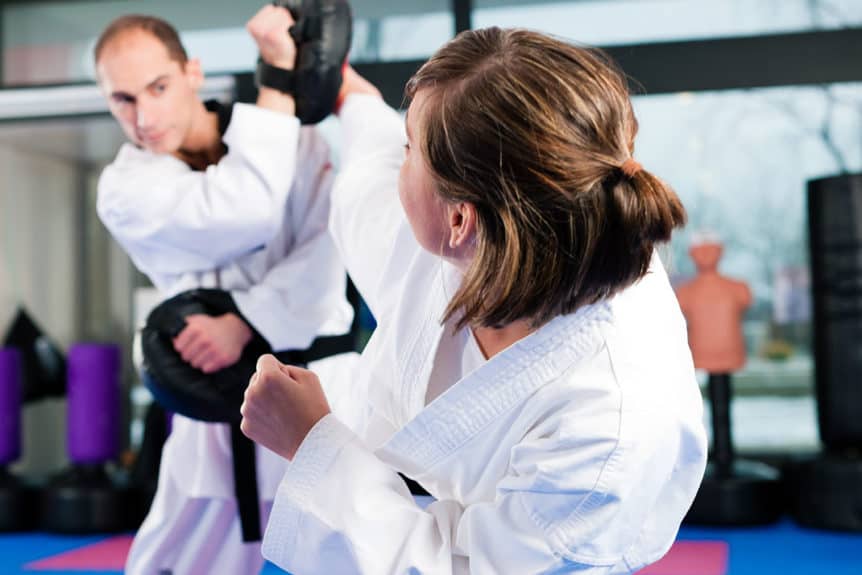
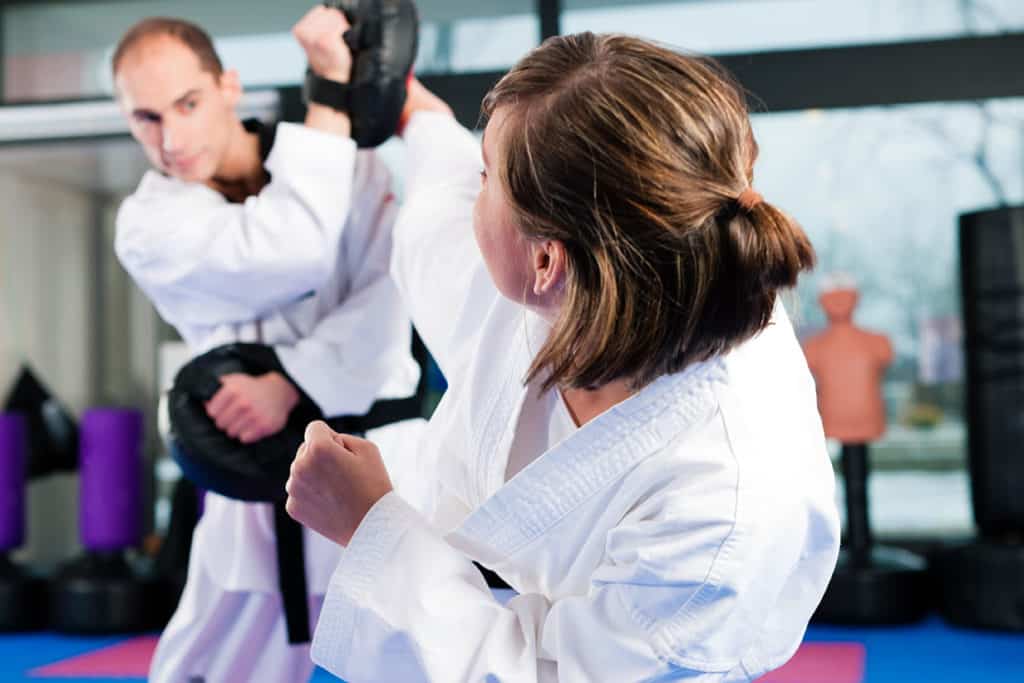
Taekwondo kicking drills are short, repeatable exercises that build one part of a kick at a time: speed, power, accuracy, balance or timing. You can do them on target paddles, a kick shield or a heavy bag, with a partner, or alone with no equipment at all. The best results come from a short warm-up, a few focused drills done with clean technique, rest between rounds and equal work on both legs.
| What they build | Speed, power, accuracy, balance, combinations, footwork and flexibility |
|---|---|
| Equipment | Target paddles, kick shield, heavy bag, or none for solo drills |
| Best kicks to start with | Front kick (ap chagi), roundhouse kick (dollyeo chagi), side kick (yeop chagi) |
| Session length | About 30 minutes, including warm-up and cool-down |
| How often | Two or three times a week on top of regular classes works for most beginners |
| Golden rule | Clean technique first, then speed, then power |
Before you kick
Warm up before kicking drills
Cold muscles kick lower and slower, and they are easier to strain. Spend 8 to 10 minutes getting warm before you start any drill. A good warm-up raises your heart rate first, then moves the hips, knees and ankles through the ranges you will use when you kick.
- Light cardio, 3 to 4 minutes. Jog in place, skip rope or bounce on the balls of your feet in a fighting stance.
- Joint circles. Roll the ankles, knees and hips in both directions.
- Leg swings. Swing each leg forward and back, then side to side, 10 times each way. Start low and let the height rise gradually.
- Knee raises and chambers. Lift the knee into the chamber position for front, roundhouse and side kicks without extending the leg.
- Slow kicks. Throw 5 easy kicks of each type per leg at half speed and waist height before you go any higher or faster.
For a full routine, see the taekwondo warm-up exercises guide, and save long static stretches for after training (see dynamic vs. static stretching).
Note
This is general information, not medical advice. Warm up every time, stop if a kick causes sharp pain in the knee, hip, groin or foot, and check with a doctor before starting a new training plan if you have an injury or health condition.
By equipment
Kicking drills by equipment
Each piece of equipment trains something different. Paddles reward speed and accuracy, shields and bags reward power, and solo and partner drills build balance and timing.
Target paddle drills
A target paddle (also called a kicking paddle or kick target) is a light, hand-held pad. It makes a sharp slap when you hit it cleanly, which tells you right away if the kick landed with the right surface.
- Rapid-fire roundhouse: the holder keeps the paddle at stomach height. Kick with the same leg as many times as you can in 10 seconds while keeping a clean chamber. Switch legs.
- Flash target: the holder hides the paddle, then shows it at a random height for a second. Kick as soon as it appears. This trains reaction time.
- Double paddle switch: the holder holds two paddles. Kick one with a roundhouse, switch your feet in place and kick the other with the opposite leg.
- Moving target: the holder steps back, sideways or forward, then stops and shows the paddle. Close the distance and kick on the stop.
Kick shield drills
A kick shield is a thick, rectangular pad held against the holder’s body or forearm. It absorbs hard kicks, so it is the right tool for power work.
- Power side kick: the holder braces with one foot back. Throw 5 to 8 hard side kicks per leg, chambering fully each time.
- Push kick: use a push kick (mireo chagi) to drive the holder back one step. Focus on pushing with the hips, not only the leg.
- Back kick: from a fighting stance, turn and throw a back kick (dwi chagi) into the center of the shield. Look over your shoulder before you kick so you hit the target.
- Step-in roundhouse: step forward, then land one strong roundhouse. Reset and repeat.
Tip for pad holders
Hold paddles and shields away from your face and body, keep your fingers behind the pad, and angle the pad to match the kick: flat facing the kicker for front and side kicks, turned slightly for roundhouse kicks. Brace harder for power kicks than for speed drills.
Heavy bag drills
A heavy bag lets you practice power and combinations without a partner. Kick with the correct surface every time, and stand far enough away that the kick lands at full extension, not with a bent knee jammed against the bag.
- Timed rounds: kick for 1 minute, rest 1 minute, three to five rounds. Mix kicks or pick one kick per round.
- Power ladder: 1 roundhouse, reset; 2 roundhouses, reset; up to 5, then back down to 1.
- Low, middle, high: three roundhouses with the same leg, one at thigh height, one at stomach height and one as high as you can kick with control.
- Kick and return: land a kick, then step back to your stance with your guard up before the next one. This builds the habit of recovering after every kick.
For bag choices, especially for children, see kicking bags for kids. Kicking a hard bag often can bruise the shins and feet; build up slowly (see shin conditioning for taekwondo).
Solo drills with no equipment
You don’t need gear to improve your kicks. Solo drills are the easiest way to build balance and a clean kicking path, and you can do them at home with a little space (see how to practice taekwondo at home).
- Chamber holds: lift into the chamber for a front, roundhouse or side kick and hold for 5 to 10 seconds. Three holds per kick, per leg.
- Wall or chair kicks: hold a wall or the back of a sturdy chair and kick slowly, 10 per leg, checking the chamber, foot position and recoil.
- Slow-motion kicks: take about five seconds to complete each kick, from chamber to extension to recoil. Wobbles show where balance breaks down.
- No-touch repeats: throw 3 to 5 roundhouse or side kicks in a row without putting the kicking foot down.
- Shadow kicking: move around in a fighting stance and throw kicks at an imaginary opponent, mixing in steps forward, back and to the side.
Partner drills
Partner drills add timing and distance, the two things solo practice can’t teach. Wear the protective gear your school requires for any drill with contact.
- Mirror drill: one partner moves and the other copies, staying at kicking distance. On a signal, the follower throws a kick at a held paddle.
- Number calls: the holder calls a number, and each number means a kick or combination (for example, 1 is a roundhouse, 2 is a double roundhouse, 3 is a back kick).
- Counter drill: one partner steps in, and the other answers with a front-leg kick to stop the advance, then a roundhouse.
- Distance game: the holder moves freely, and the kicker scores only when the kick lands at full extension.
Many of these build on the footwork in the taekwondo footwork drills guide.
By goal
Kicking drills by goal
| Goal | What helps | Example drill |
|---|---|---|
| Speed | Short bursts at full speed, a relaxed leg and a fast recoil | Rapid-fire roundhouse on a paddle for 10 seconds |
| Power | Full chamber, hip turn and a solid base | Power side kicks on a kick shield |
| Accuracy | Small targets and clean striking surfaces | Flash target, or kicking a small paddle at one height |
| Balance | Slow kicks and holds on the standing leg | Chamber holds and slow-motion kicks |
| Combinations | Linking kicks without stopping between them | Number calls with a partner |
| Footwork | Kicking after a step, switch or slide | Moving target or step-in roundhouse |
| Flexibility | Leg swings before training, longer stretches after | Low, middle, high roundhouses on the bag |
Speed
Speed comes from a relaxed leg, a short path and a quick recoil. Keep speed rounds short, 10 to 15 seconds, and rest fully between them so every kick stays fast. More ideas are in how to kick faster in taekwondo.
Power
Power comes mostly from the hips and the base, not from swinging the leg harder. Chamber fully, turn the hip into the kick and keep the standing foot planted and pivoting. Leg and core strength help too (see strength training for taekwondo).
Accuracy and balance
Accuracy drills use small targets and ask for the right striking surface every time: the ball of the foot for a front kick, the instep or ball of the foot for a roundhouse, the heel or blade of the foot for a side kick. Balance drills slow everything down. For more, see how to improve balance in taekwondo.
Combinations and footwork
Once single kicks are clean, link them. Start with two-kick combinations, such as a front-leg roundhouse followed by a back-leg roundhouse, and add a step or switch before the first kick. The taekwondo combination kicks guide has more patterns.
Flexibility
Higher kicks need flexible hamstrings, hips and groin muscles. Use leg swings and controlled kicks to loosen up before drills, and do longer, gentle stretches after training when the muscles are warm.
Note
This is general information, not medical advice. Stretch to mild tension, never to pain, and don’t bounce into a stretch or force a split. Young children and anyone coming back from an injury should build range slowly with an instructor’s guidance.
Sample plan
A sample 30-minute kicking session
This session works for beginners with a heavy bag or a partner holding pads. Swap in solo drills if you have no equipment.
- Minutes 0 to 8: Warm-up. Light cardio, joint circles, leg swings and slow kicks.
- Minutes 8 to 13: Technique. Chamber holds and slow-motion front, roundhouse and side kicks, both legs.
- Minutes 13 to 19: Speed. Rapid-fire roundhouse on a paddle or bag, 10 seconds on and 30 seconds off, four rounds per leg.
- Minutes 19 to 25: Power or combinations. Power side kicks on a shield, or three 1-minute bag rounds of two-kick combinations with 1 minute of rest.
- Minutes 25 to 30: Cool-down. Walk, breathe and do gentle hamstring, hip and groin stretches.
Drink water during the session, and leave at least a day between hard kicking sessions so the legs can recover.
Tip
Write down one thing to improve before each session, such as “higher chamber on the left leg,” and check it at the end. Small, specific goals add up faster than random practice.
Mistakes
Common kicking drill mistakes
- Skipping the warm-up. Jumping straight into fast or high kicks is a common way to pull a hamstring or groin muscle.
- Training only the strong leg. Match the reps on both sides, or add a little extra work for the weaker leg.
- Speed before technique. Fast kicks with a low chamber or the wrong striking surface only make the bad habit faster.
- Dropping the hands. Keep your guard up during every drill, the same as in sparring.
- Standing too close to the bag. A jammed kick hits with the shin or knee and teaches poor distance.
- Locking the knee. Snapping the leg straight hard at full extension strains the joint. Stop just short of full lock.
- No rest. Long, nonstop rounds turn speed work into tired, sloppy kicking.
Safety
Kicking drill safety
- Check the space. Clear the floor, and make sure no one can walk into a kicking leg.
- Use the right surface and gear. Wrap or protect the feet and shins on hard bags if your school recommends it, and wear full protective gear for contact partner drills.
- Build volume slowly. Add rounds or reps a little at a time instead of doubling your work in one week.
- Supervise children. Kids should do partner and bag drills with an adult or instructor watching, at light contact.
- Respect pain. Soreness the next day is normal; sharp or lasting joint pain is not.
Note
This is general information, not medical advice. If pain in a knee, hip, ankle or foot doesn’t go away with rest, stop kicking drills and see a doctor (see common taekwondo injuries).
Sparring
How kicking drills carry over to sparring
Drills only help in sparring (kyorugi) if they match how kicks score. Under World Taekwondo competition rules, a kick to the trunk protector scores 2 points, a kick to the head scores 3, and a turning kick (one thrown with a spinning body turn, such as a back kick) scores 4 to the trunk and 5 to the head. That is why many sparring drills focus on fast front-leg roundhouse kicks to the body, quick head kicks and well-timed back kicks. Other organizations, such as the ITF and ATA, use their own scoring rules. See taekwondo sparring and tournament rules for details, and the taekwondo kicks guide for every kick by name.
FAQ
Frequently asked questions
What are the best kicking drills for beginners?
Start with chamber holds, slow-motion kicks and wall-supported kicks to build balance and a clean kicking path. Then add target paddle drills for speed and accuracy and heavy bag rounds for power. Focus on the front kick, roundhouse kick and side kick first.
How do you practice taekwondo kicks at home without equipment?
Use solo drills: chamber holds, slow-motion kicks, kicks while holding a wall or sturdy chair, repeated kicks without putting the foot down, and shadow kicking in a fighting stance. Clear enough space so you can kick without hitting furniture.
How often should you do kicking drills?
Two or three short sessions a week on top of regular classes works for most beginners. Leave at least a day between hard kicking sessions so the legs can recover, and add volume slowly.
Is a heavy bag or a target paddle better for kicking practice?
They train different things. Target paddles are best for speed, accuracy and reaction time. A heavy bag or kick shield is better for power and for longer rounds. Most students benefit from using both.
How do you make taekwondo kicks faster?
Keep the leg relaxed until impact, use a high chamber and a short path, and pull the foot back quickly. Train speed in short bursts of 10 to 15 seconds with full rest between rounds so every kick stays sharp.
How long should a kicking practice session be?
About 30 minutes is enough for a focused session: roughly 8 minutes of warm-up, 15 to 17 minutes of drills and 5 minutes of cool-down and stretching.
The short version
Warm up first, pick one or two goals, and use the right tool: paddles for speed and accuracy, shields and bags for power, solo drills for balance and partner drills for timing. Keep technique clean, rest between rounds and train both legs. Start with the front kick and roundhouse kick, and add harder drills as your kicks get cleaner.