


A taekwondo sparring combination is two or more techniques thrown in a quick, planned sequence, usually kicks at different heights or angles. The first kick sets up the next: it draws a block, moves the opponent or tests their reaction, and the follow-up scores. This guide covers the sparring stance, the principles behind good combos, ten combinations from beginner two-kick sets to advanced three-kick sequences, and drills to make them fast and automatic.
| What a combo is | Two or three techniques in a planned sequence |
|---|---|
| Why use them | A single kick is easy to read; combos break the opponent’s guard and timing |
| Key principle | Change level (body then head), angle or rhythm between kicks |
| Beginner combos | Two kicks: front-front, roundhouse-roundhouse, front-side |
| Advanced combos | Three kicks, spinning and jumping kicks, cut kicks and feints |
| Base | A balanced, mobile sparring stance and good footwork |
Stance
The taekwondo sparring stance
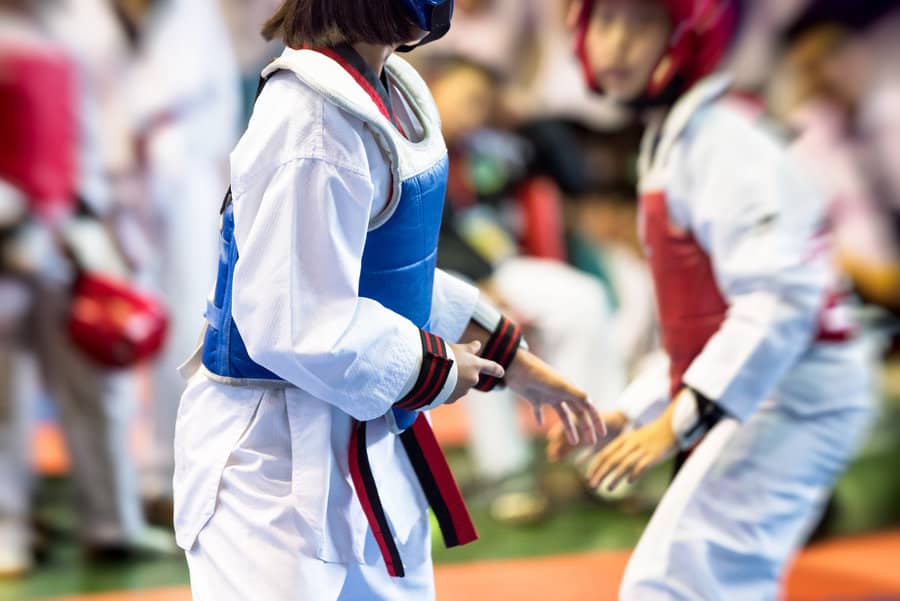
Every combination starts from the fighting stance (gyeorugi junbi). In Olympic-style sparring it is a side-on stance that lets you kick quickly with either leg and move in any direction.
- Feet: about shoulder width or a little wider, lead foot pointing toward the opponent, rear foot turned out.
- Body: turned partly sideways to give a smaller target; knees soft.
- Weight: on the balls of the feet, spread fairly evenly so you can kick off either leg; many fighters bounce lightly to stay ready.
- Hands: up, guarding the body protector and head; the rear hand covers the face.
- Closed vs open stance: in a closed stance both fighters have the same leg forward; in an open stance they have opposite legs forward. The best opening kicks change with each, so practice combos from both.
See taekwondo stances for the formal stances used in forms.
Principles
How to build a good combination
Levels
Change height
Kick to the body to bring the guard down, then to the head, or the other way around.
Decoy
Set up with a fast first kick
A short, quick first kick draws a reaction; the second kick carries the full power.
Angles
Mix lines
Combine straight kicks (front, side, back) with circular ones (roundhouse, hook) so the opponent cannot block both.
Rhythm
Break the timing
Vary the pause between kicks; a broken rhythm is harder to counter than a steady one-two.
Keep combinations short. Two or three kicks is usually the practical limit before you need to reset your distance, and every extra kick gives the opponent time to counter.
Two kicks
Basic two-kick combinations
Learn these first, slowly on pads, then at speed. “Back leg” means the rear leg; “front leg” means the lead leg.
| Combination | How to do it |
|---|---|
| Front kick, front kick | Back leg front kick to the body, land forward, then the other back leg front kick to the head. Usually the first combo students learn. |
| Front kick, side kick | Front kick high to raise the guard, then a side kick to the body. |
| Roundhouse, roundhouse (double) | Back leg roundhouse to the body, land, and switch straight into a roundhouse with the other leg to the body or head. |
| Push kick, roundhouse | Front leg push (cut) kick to stop the opponent and check their reaction, then a back leg roundhouse to the body or head. |
| Roundhouse, back kick | Back leg roundhouse to the head; as the opponent moves in or the leg lands, spin into a back kick to the body. |
| Roundhouse, outside crescent | Back leg roundhouse to the body, drop the leg, then an outside crescent kick to the head. Works best against opponents your height or shorter. |
For technique on the individual kicks, see the roundhouse kick and taekwondo kicks.
Three kicks
Advanced three-kick combinations

These suit higher color belts and black belts with good balance and flexibility.
| Combination | How to do it |
|---|---|
| Front leg roundhouse, front leg side kick, spinning back kick | Front leg roundhouse to the body, front leg side kick without setting the foot down for long, then spin into a back kick to the head or body. |
| Push kick, crescent kick, tornado kick | Back leg push kick to drive the opponent back, step through, crescent kick with the same leg, set it down and finish with a tornado (360-degree) roundhouse to the body. |
| Hook kick, side kick, roundhouse | Front leg hook kick to the head, front leg side kick to the body, back leg roundhouse to the head: a high, low, high pattern that needs good flexibility. |
| Axe kick, roundhouse, back kick | Front leg axe kick to the head, back leg roundhouse to the body, then a back kick to the body or head. |
| Front kick, front leg roundhouse, back kick | Two quick front leg kicks (front kick to the body, roundhouse to the head), then a back kick to the body. |
Tip
In Olympic-style scoring, spinning kicks earn extra points (4 to the body, 5 to the head), so many advanced combinations finish with a spinning back kick or spinning hook kick. See Olympic taekwondo scoring.
Practice
Drills for faster combinations
- Pad work: a partner holds two pads at different heights and calls the combo; start slow, then add speed.
- Shadow sparring: run each combination from the fighting stance, both closed and open, then move out of range.
- Reaction drills: the pad holder shows a target only for a moment; you fire the right combo.
- Footwork: step in, step back, switch feet and slide before and after each combo. See footwork drills.
- Speed and flexibility: see how to kick faster and stretching for taekwondo.
- Controlled sparring: try one or two combos per round against a partner, with full gear.
For more on strategy, distance and rules, see the taekwondo sparring guide, sparring and tournament rules, one-step sparring and sparring gear.
FAQ
Frequently asked questions
What is a combination in taekwondo sparring?
Two or more techniques thrown in a quick, planned sequence, where the first sets up the next by drawing a block, moving the opponent or changing the target height.
What is the best taekwondo combo for beginners?
Front kick then front kick, or a double roundhouse kick. They are simple, balanced and teach you to land and kick again quickly.
What is the taekwondo sparring stance?
A side-on fighting stance with feet about shoulder width apart, weight on the balls of the feet, knees soft and hands up guarding the body and head.
How many kicks should a combination have?
Usually two or three. Longer combinations leave you off balance and give the opponent time to counter.
What combinations do black belts use?
Three-kick sequences, feints and cut kicks to set up openings, and finishes with spinning or jumping kicks such as the spinning back kick, spinning hook kick or tornado kick.
How do I make my combinations faster?
Drill them on pads and in shadow sparring until they are automatic, keep the first kick short, work on footwork and flexibility, and stay relaxed between kicks.
The short version
Build sparring combinations from a balanced side-on stance. Use the first kick to draw a reaction and change height, angle or rhythm for the next. Start with two-kick combos like front-front and double roundhouse, move to three-kick sequences ending in spinning kicks, and drill them on pads and with footwork until they are fast and automatic.