

To prepare for a taekwondo tournament, start four to eight weeks out: build sparring fitness, practice full rounds in all your gear, and polish a few techniques you trust rather than learning new ones. Learn your event’s rules and divisions, check your gear and uniform meet them, and plan your weigh-in if you compete by weight. The night before, pack your bag, eat a normal meal and sleep well. On the day, arrive early, warm up properly, keep moving and eating light between matches, listen to your coach, and review your matches afterward, win or lose.
| When | What to do |
|---|---|
| 4 to 8 weeks out | Sparring fitness, full rounds in gear, sharpen 2 or 3 combinations, practice your form |
| Final week | Train lighter, check rules, gear, uniform and weight |
| Night before | Pack your bag, normal dinner, early night |
| Tournament day | Arrive early, warm up, check brackets, stay ready between matches |
| Afterward | Rest, watch your video, note what to work on |
Health
This is general information, not medical advice. Young athletes, anyone with a health condition and anyone cutting weight should get advice from a doctor and a qualified coach. Never use rapid weight loss, dehydration or saunas to make weight.

The basics
How taekwondo tournaments work
Most tournaments offer sparring (kyorugi), forms (poomsae or patterns) and sometimes board breaking, team demonstrations or other events. Competitors are grouped into divisions by age, gender and rank, and in sparring also by weight. Rules depend on the organization: World Taekwondo (WT) events use Olympic-style rules with electronic scoring, ITF events use their own rules, and many local and school tournaments use point sparring, where judges score clean techniques by eye. Read the rules for your event before you start preparing. See taekwondo sparring and tournament rules.
How sparring is scored in World Taekwondo events
- Points: 1 for a punch to the trunk, 2 for a kick to the trunk, 3 for a kick to the head, with extra points for turning and spinning kicks.
- Penalties: each gam-jeom gives the opponent 1 point.
- Rounds: senior matches are best of three rounds of 2 minutes, with 1 minute of rest; youth and local events often use shorter rounds.
- Scoring: kicks are scored by the electronic protector and sensor system, and judges score punches and the extra points for turning kicks.
See the role of the referee in taekwondo and taekwondo at the Olympics.
Weeks before
How to prepare in the weeks before
- Build sparring fitness: a 2-minute round at full effort is harder than it looks. Add interval work such as sprints, skipping, bag rounds and footwork drills on top of class. See a 12-week conditioning plan and footwork drills.
- Spar full rounds in full gear: wear everything you will compete in, mouthguard included, so the gear feels normal. Practice the round length and rest your event uses.
- Sharpen a small game plan: pick two or three combinations and a counter you can land under pressure, and practice moving off the line after every attack. See taekwondo combination kicks and sparring tips.
- Strengthen your core and legs: core work and leg strength help you absorb contact, kick harder and stay balanced. See strength training for taekwondo.
- Polish your form: for poomsae events, perform your form in front of your instructor and on video, working on stances, timing, power and focus. See poomsae training.
- Practice nerves: do mock matches with your school watching, and rehearse slow breathing and visualization. See martial arts meditation and mindfulness.
The final week
Cut back on hard training in the last few days so you arrive fresh, keeping sessions short and sharp. Confirm your registration, division, schedule, weigh-in time and the gear rules. If you compete by weight, make sure you are already close to your division weight; plan this with your coach well in advance rather than trying to drop weight in the last days.
Gear and uniform
Gear, uniform and rules checks
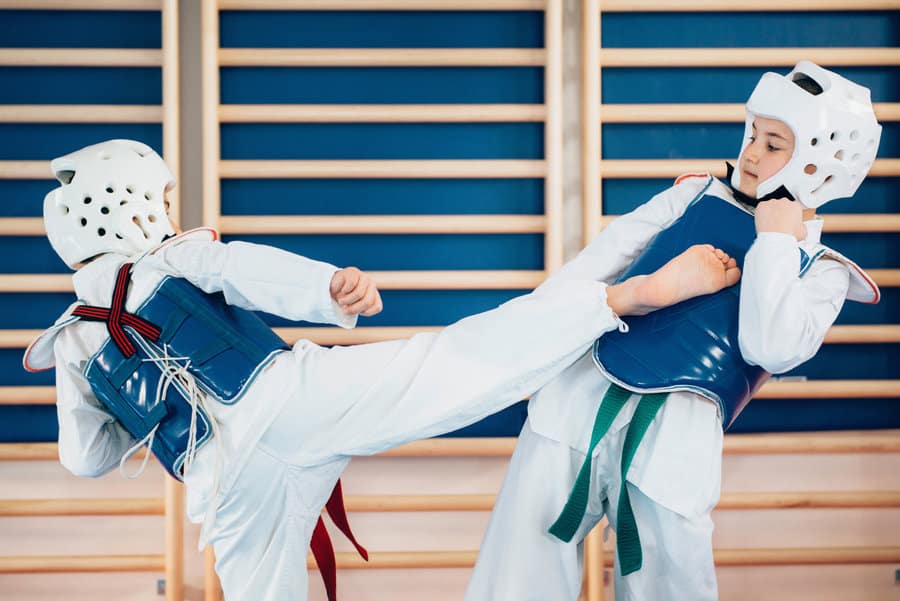
- Sparring gear: typically a headgear, trunk protector (hogu), forearm guards, shin guards, groin guard and mouthguard, plus gloves and foot protectors or sensor socks depending on the event. Check what the rules require and what the organizer provides. See sparring gear for kids.
- Approved brands: sanctioned events may require gear approved by their federation, so check before you buy.
- Uniform: clean, the right size and the type your event requires, with your belt tied correctly. Bring a spare if you can. See how to buy a taekwondo uniform.
- Name everything: label your gear and bag, since many pieces look the same.
- Nails and jewelry: trim fingernails and toenails and remove all jewelry, including earrings.
- Glasses: glasses are often not allowed in sparring, so ask the organizer about contact lenses or approved sports goggles.
- Hair: tie long hair back with a soft band without metal parts.
Packing list
What to bring to a taekwondo tournament
Uniform, belt, all sparring gear, mouthguard, registration confirmation and ID if required.
Water bottle, plus light snacks such as bananas, crackers or sandwiches for long waits.
Sandals or flip-flops, warm-up clothes, a towel and a change of clothes for afterward.
A small first aid kit, hair ties, wipes, some cash and a phone charger.
Tournament day
On the day of the tournament
Eat, drink and rest
Get a good night’s sleep and eat a normal breakfast you know agrees with you, two to three hours before your first match. Sip water through the day and eat small, light snacks between divisions rather than a big meal. Avoid trying new foods or drinks on competition day. See diet for taekwondo.
When you arrive

Arrive early so you have time to check in, find your ring and look at the brackets and schedule. Walk the mat area so it feels familiar. Start a full warm-up about 20 to 30 minutes before you expect to compete: light jogging, joint circles for the ankles, knees, hips and wrists, dynamic stretches and a few fast kicks. See warm-up exercises.
Between matches
- Expect to wait: big events can run hours behind, so keep warm with light movement and stay near your ring.
- Listen to your coach: follow your instructor’s advice between rounds and matches, and watch how they coach teammates.
- Watch your division: notice which kicks and habits upcoming opponents use.
- Stick to your game plan: nerves make people abandon their best techniques; stay with what you have practiced.
- Respect everyone: bow, shake hands and accept the officials’ decisions, whatever the result.
Tip
Between matches, keep a jacket on, sip water and do a few kicks and footwork drills every 15 to 20 minutes so you are warm when your name is called.
Parents
Tips for parents
- Help your child pack the night before and check the gear list together.
- Bring food, water and something to do during long waits.
- Follow the event’s rules on where parents can sit and on photos and video; avoid flash near the mat.
- Leave coaching to the instructor during matches and focus on encouragement.
- Video your child’s matches so you can review them together later, calmly and at home.
Afterward
After the tournament
Rest, eat a proper meal and check any knocks or bruises. Over the next few days, watch your match video with your instructor and ask: what worked, what did not, and what to train next. Every tournament, won or lost, shows you exactly what to work on. See common taekwondo injuries.
FAQ
Frequently asked questions
How do taekwondo tournaments work?
Competitors are grouped into divisions by age, gender, rank and, for sparring, weight. Events usually include sparring and forms, and sometimes breaking or demonstrations. Rules depend on the organization, such as World Taekwondo, ITF or local point-sparring rules.
How is sparring scored in a taekwondo tournament?
Under World Taekwondo rules, a punch to the trunk scores 1 point, a trunk kick 2 and a head kick 3, with extra points for turning kicks, and each penalty gives the opponent 1 point. Point-sparring tournaments use their own scoring, judged by eye.
How long is a taekwondo sparring match?
Senior World Taekwondo matches are best of three rounds of 2 minutes with 1 minute of rest. Youth and local tournaments often use shorter rounds, so check your event’s rules.
What should I eat before a taekwondo tournament?
Eat a normal, familiar breakfast two to three hours before you compete, drink water through the day and have light snacks such as bananas or crackers between matches. Avoid new foods on competition day.
What should I bring to a taekwondo tournament?
Your uniform and belt, all required sparring gear and mouthguard, registration details, water, light snacks, sandals, warm-up clothes, a towel and a change of clothes.
How do I deal with tournament nerves?
Practice mock matches in front of people, stick to a simple game plan, use slow breathing before you step on the mat and focus on the next exchange rather than the result. Nerves are normal and usually ease once the match starts.
The short version
Start preparing four to eight weeks out with sparring fitness, full rounds in gear and a few trusted combinations. Learn your event’s rules, check gear, uniform and weight, then taper in the final week. On the day, arrive early, warm up, eat light, stay warm between matches, listen to your coach, and review your video afterward.