
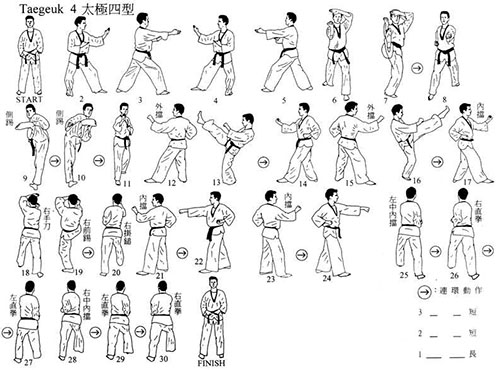
Taegeuk Sa Jang (태극 4장) is the fourth of the eight Taegeuk poomsae, the color belt forms of Kukkiwon and World Taekwondo, and in many schools it is the green belt form. It stands for Jin, the trigram of thunder. Most schools count it as 20 movements, with one kihap on the last punch. It is the form where students first use the double knife-hand block in back stance, the spear-hand thrust, the swallow-form neck strike, two side kicks in a row and the back-fist strike, and it ends on the same spot where it began.
| Korean | 태극 4장 (Taegeuk Sa Jang) |
|---|---|
| Trigram | Jin ☳, thunder |
| Usual rank | Green belt, around 6th or 5th gup (varies by school) |
| Movements | 20, as most schools count them |
| Kihap | Movement 20, on the final punch |
| Before and after | Taegeuk Sam Jang (3) and Taegeuk O Jang (5) |
Meaning
What Taegeuk Sa Jang means
Each Taegeuk form is linked to one of the eight trigrams of the I Ching. Sa Jang is linked to Jin, the trigram of thunder, which stands for great power and dignity. The form is often explained as a lesson in staying calm and brave when danger comes, the way a thunderstorm is frightening but passes as quickly as it arrives. “Sa” is the Sino-Korean number four; see taekwondo numbers.
For how all eight forms fit together, see what poomsae are.
Techniques
New techniques in Taegeuk Sa Jang
Sonnal momtong makgi
Double knife-hand block
A middle block with both hands open, made in back stance. It opens the form and returns after the side kicks.
Pyeonsonkkeut sewo jjireugi
Spear-hand thrust
A thrust with the fingertips of a flat, vertical hand while the other hand presses down under the elbow.
Jebipoom mok chigi
Swallow-form neck strike
A knife-hand strike to the neck with one hand while the other knife hand blocks high above the head.
Yeop chagi
Two side kicks
A left side kick followed straight away by a right side kick, which tests balance and control.
Ap chagi and makgi
Kick and return
A front kick that returns to the same back stance, followed by a middle block without moving forward.
Deungjumeok ap chigi
Back-fist strike
A strike to the face with the back of the fist, delivered after a front kick in front stance.
Brush up on the basics in taekwondo stances, taekwondo blocks and taekwondo kicks.
Step by step
Taegeuk Sa Jang step by step
Start in the ready stance (junbi) facing the front. The directions below are from your point of view.
- 1. Turn left into a left back stance with a double knife-hand middle block.
- 2. Step forward into a right front stance with a right spear-hand thrust, left hand pressing down under the right elbow.
- 3. Turn 180 degrees to the right into a right back stance with a double knife-hand middle block.
- 4. Step forward into a left front stance with a left spear-hand thrust, right hand under the left elbow.
- 5. Turn left to face the far end into a left front stance with a right knife-hand neck strike and a left knife-hand high block (swallow form).
- 6. Right front kick, step forward, left middle punch.
- 7. Left side kick.
- 8. Right side kick, landing in a back stance with a double knife-hand middle block.
- 9. Turn 270 degrees to the left into a back stance with an outside middle block.
- 10. Right front kick without moving forward, return the foot to the same back stance, and make an inside middle block.
- 11. Turn 180 degrees to the right into a back stance with an outside middle block.
- 12. Left front kick without moving forward, return the foot, and make an inside middle block.
- 13. Turn left to face the far end into a front stance with the swallow-form neck strike.
- 14. Right front kick, step forward into a right front stance with a right back-fist strike.
- 15. Turn left into a left walking stance with a left middle block.
- 16. Without moving the feet, right middle punch.
- 17. Turn 180 degrees to the right into a right walking stance with a right middle block.
- 18. Without moving the feet, left middle punch.
- 19. Turn to face the far end into a left front stance with a left middle block, then right and left middle punches.
- 20. Step forward into a right front stance with a right middle block, then left and right middle punches with a kihap. Turn 180 degrees to the left, back to the ready stance where you started.
Tip
Schools name a few of these blocks differently, and some count the form as 18 or more movements. Learn the version your instructor teaches, and use the video to check the direction of each turn.
Practice
Tips for practicing Taegeuk Sa Jang
- Finish where you started. If you end off your start mark, a stance is too long or too short somewhere.
- Keep the side kicks controlled: chamber the knee, kick, and recover before the next kick.
- Return cleanly after each front kick in movements 10 and 12 so the back stance is the same as before the kick.
- Turn your head first and look at the imaginary opponent before each block or strike.
- Exhale on each technique and save a strong kihap for the last punch. See the kihap.
- Wait for the instructor’s command to return to the ready stance after the last move.
Green belt
Taegeuk Sa Jang and the green belt
In many Kukkiwon and World Taekwondo schools, students learn one Taegeuk form per color belt, so the fourth form usually falls at green belt. Green often stands for the growth of a plant, as students build on the basics from their first belts. Belt colors and the order of forms vary between schools, so check your school’s syllabus. See the taekwondo belt order.
The forms before and after it: Taegeuk Il Jang, Taegeuk I Jang, Taegeuk Sam Jang and Taegeuk O Jang. For the Korean names of each move, see taekwondo terminology.
FAQ
Frequently asked questions
What is Taegeuk Sa Jang?
The fourth of the eight Taegeuk poomsae taught in Kukkiwon and World Taekwondo schools. It represents Jin, the trigram of thunder.
How many moves are in Taegeuk Sa Jang?
Most schools count 20 movements, including six kicks. Some count the movements differently, so follow your instructor’s count.
What belt is Taegeuk Sa Jang for?
It is usually the green belt form, around 6th or 5th gup, but the exact belt depends on the school.
Where is the kihap in Taegeuk Sa Jang?
On the final punch of movement 20, just before you turn back to the ready stance.
What does Sa Jang mean?
“Sa” is the Sino-Korean number four and “jang” means chapter, so Sa Jang is the fourth chapter of the Taegeuk series.
What form comes after Taegeuk Sa Jang?
Taegeuk O Jang, the fifth Taegeuk form, which represents Son, the trigram of wind.
The short version
Taegeuk Sa Jang is the fourth Taegeuk poomsae and a common green belt form. It represents thunder, has 20 movements in most schools, and introduces the double knife-hand block, spear-hand thrust, swallow-form strike, two side kicks and back-fist strike. Finish where you started and kihap on the last punch.