

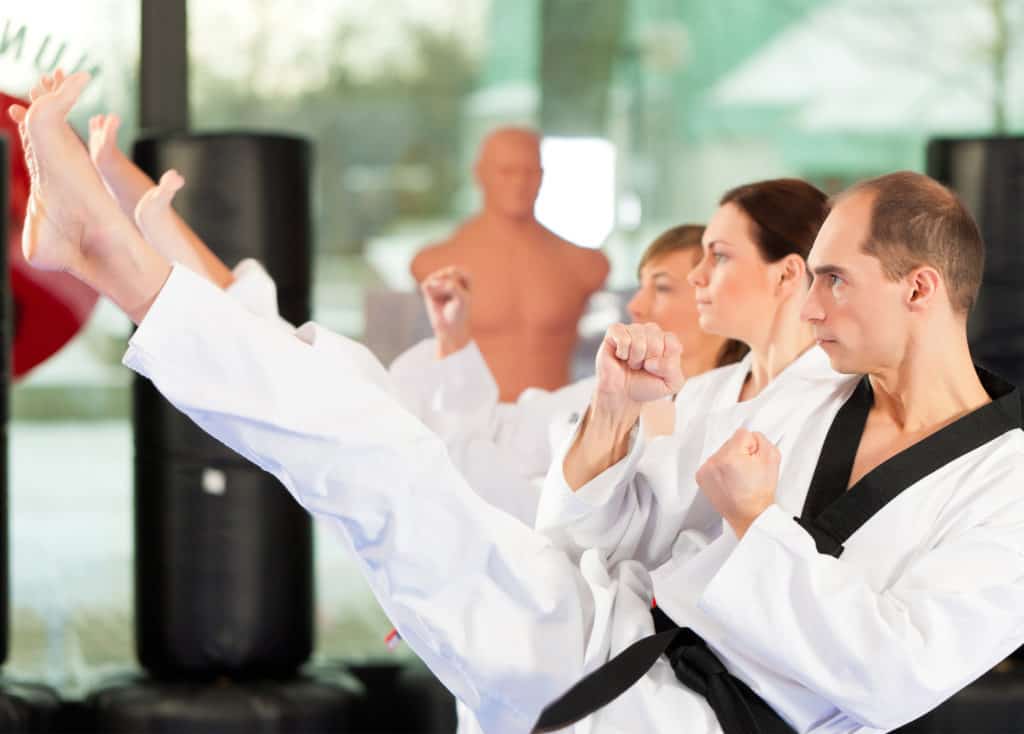
The front kick, called ap chagi in Korean, is the first kick most taekwondo students learn. You lift your knee, snap your lower leg straight forward, strike with the ball of your foot and pull the leg back before setting it down. It is fast, has good reach and sets up almost every other kick, so it is worth getting right from the start.
| Korean name | Ap chagi (앞차기) |
|---|---|
| Striking surface | Ball of the foot (ap chuk), toes pulled back |
| Main targets | Stomach, solar plexus, chest and, with practice, the chin |
| When you learn it | White belt; it appears in the first form, Taegeuk Il Jang |
| Used in | Forms, sparring, board breaking and self-defense |
| Main variations | Push front kick, front-leg front kick, repeating front kick, upward front kick |
Technique
How to do a front kick, step by step
- Start in a stance with your guard up. Beginners usually kick from a front stance or a fighting stance, hands up to protect the face (see taekwondo stances).
- Chamber the kicking leg. Lift the back knee straight up in front of you, at least to waist height, with the heel pulled toward your hip. Pull your toes back so the ball of the foot faces the target.
- Extend and strike. Snap the lower leg forward from the knee and push your hip slightly into the kick. Hit with the ball of the foot, not the toes. Your standing foot can pivot a little to let the hip turn in.
- Recoil. Pull the foot straight back to the chamber position as fast as it went out, so an opponent can’t catch your leg.
- Set the foot down. Place it forward into a new stance or back where it started, with your guard still up.
- Breathe out as you kick. A sharp exhale, or a kihap in class, tightens your core and adds power.
Tip
Practice the kick slowly in front of a mirror first. Hold the chamber for a two-count, extend slowly, hold, recoil and set down. Speed comes once the path is clean (see how to kick faster).
Mistakes
Common front kick mistakes
- Kicking with the toes. It hurts and can jam or break a toe. Pull the toes back and land on the ball of the foot.
- A low chamber. If the knee stays low, the foot swings up in an arc instead of going straight to the target.
- Leaning far back. A small lean is natural, but leaning too far kills your power and balance. Keep your shoulders over your hips (see how to improve balance in taekwondo).
- Dropping the hands. Your guard should stay up during the whole kick, especially in sparring.
- Leaving the leg out. No recoil means less snap and an easy leg to grab.
- Snapping the knee straight. Locking the knee hard at the end of the kick strains the joint. Stop just short of full lock.
Note
This is general information, not medical advice. Warm up before kicking drills, and see a doctor if a knee, hip or foot pain doesn’t go away (see common taekwondo injuries).
Practice
Front kick drills for beginners
Do these after a full warm-up (see taekwondo warm-up and stretching). Switch legs every set so both sides develop evenly.
- Chamber holds: lift into the chamber and hold for 5 to 10 seconds, three times per leg. This builds balance and hip strength.
- Supported kicks: hold a wall or the back of a chair and kick slowly, 10 per leg, focusing on the chamber, toes and recoil.
- Slow-motion kicks: take about five seconds to complete each kick. Any wobble shows where you lose balance.
- Pad kicks: have a partner hold a kicking paddle at stomach height. Kick for accuracy first, then speed.
- Bag rounds: 30 seconds of front kicks on a heavy bag, rest 30 seconds, repeat three to five times per leg.
- Front-leg kicks: from a fighting stance, kick with the lead leg without stepping first. This is the version you will use most in sparring.
You can do most of these drills at home with a little space (see how to practice taekwondo at home).
Variations
Front kick variations
| Kick | Korean name | How it differs |
|---|---|---|
| Front snap kick | Ap chagi | The basic kick: chamber, snap, recoil |
| Push front kick | Mireo ap chagi | The sole of the foot pushes the opponent away instead of striking |
| Front-leg front kick | Ap bal ap chagi | Kicked with the lead leg for speed; common in sparring |
| Repeating front kick | Geodeup ap chagi | Several kicks in a row without putting the foot down; keep the knee high |
| Upward front kick | Ollyeo ap chagi | Swings upward, for example under the jaw, instead of straight forward |
For the full list of kicks and how they fit together, see taekwondo kicks and the basic taekwondo kicks.
In use
The front kick in forms, sparring and breaking
Forms. In World Taekwondo (Kukkiwon) schools, the front kick shows up in the very first form, Taegeuk Il Jang, followed by a step forward into a front stance and a punch.
Sparring. Under World Taekwondo rules, a front kick to the trunk protector scores 2 points and a kick to the head scores 3. Fighters often use a quick front-leg front kick to stop an opponent who is moving in, then follow with a roundhouse kick (see how to do a roundhouse kick and taekwondo sparring rules).
Board breaking. Many schools use the front kick for early board breaks at belt tests, striking with the ball of the foot or the heel (see taekwondo board breaking).
Improve
How to kick higher and harder
- Stretch the hamstrings and hips. A higher front kick comes mostly from flexibility (see dynamic vs. static stretching).
- Use the hip. Pushing the hip forward at the moment of impact adds more power than swinging the leg harder.
- Keep the knee high. Aim the knee at or above the target before you extend.
- Strengthen your core and legs. Squats, lunges and leg raises help you kick without losing balance.
FAQ
Frequently asked questions
What is ap chagi in taekwondo?
Ap chagi is the Korean name for the front kick. You lift your knee, snap your lower leg straight forward, strike with the ball of your foot and pull the leg back before setting it down. It is usually the first kick beginners learn.
What part of the foot do you hit with on a front kick?
The ball of the foot, called ap chuk in Korean, with your toes pulled back toward your shin. Some versions use the sole or heel, especially the push front kick, but you should never strike with your toes.
Is the front kick allowed in Olympic taekwondo?
Yes. Under World Taekwondo rules, a front kick that lands on the trunk protector scores 2 points and a kick to the head scores 3. In sparring, the front-leg front kick is often used to stop an opponent who is moving in.
How high should I chamber my front kick?
Lift your knee at least to waist height, and higher if your flexibility allows. A high chamber lets the kick travel straight to the target and makes it harder for an opponent to see it coming.
Why do my toes hurt when I front kick?
You are probably striking with your toes instead of the ball of your foot. Pull your toes back hard during the chamber and keep them back until the kick lands.
The short version
Chamber the knee high, pull your toes back, snap the leg forward, strike with the ball of the foot and pull it back fast. Practice slowly until the path is clean, then add speed, height and power. Once your front kick is solid, move on to the roundhouse and side kicks, and review the Korean names in the taekwondo terminology guide.