
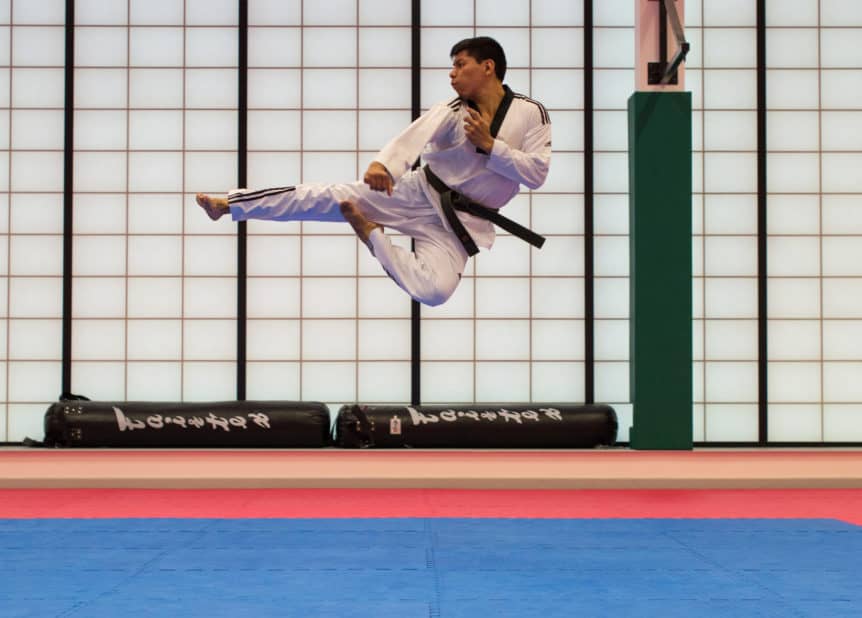
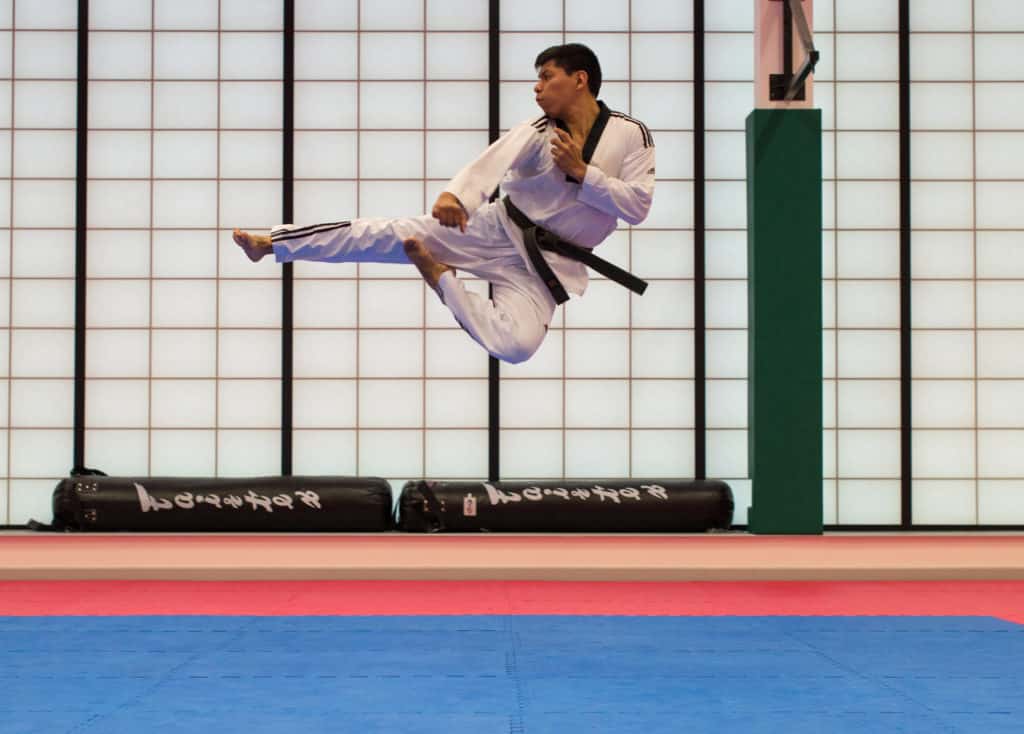
The side kick, called yeop chagi in Korean, is the most powerful straight-line kick in taekwondo. You lift the knee across your body, turn your hips and supporting foot so your side faces the target, drive the leg out in a straight line and strike with the foot blade or the heel. Then you pull the leg back along the same line and set it down. It takes longer to learn than the front kick, but once it clicks, it gives you reach, power and a strong defense against an opponent who rushes in.
| Korean name | Yeop chagi (옆차기) in Kukkiwon and World Taekwondo schools; ITF schools teach it as the side piercing kick (yop cha jirugi) |
|---|---|
| Striking surface | Foot blade (balnal), the outer edge of the foot, or the bottom of the heel (dwichuk) |
| Main targets | Ribs, stomach, chest and, with good flexibility, the head; low side kicks target the knee or thigh in self-defense |
| When you learn it | Usually at yellow or green belt; in Kukkiwon forms it first appears in Taegeuk Sa Jang |
| Used in | Forms, sparring, board breaking and self-defense |
| Main variations | Front-leg side kick, skipping side kick, pushing side kick, jumping side kick |
Basics
What is a side kick in taekwondo?
A side kick is a linear kick. The foot travels in a straight line from the chamber to the target, with your hip, leg and foot lined up behind it. That alignment is where the power comes from. Your whole body weight sits behind the strike instead of only the snap of the knee.
The kick goes out to the side of your body. Before you extend the leg, you turn so your hip and shoulder face the target and you look at it over your shoulder. That turn is the part beginners find hardest, and it is the reason the side kick usually comes after the front kick in most curriculums (see how to do a front kick).
Names change by organization. Kukkiwon and World Taekwondo (WT) schools call it yeop chagi. ITF schools spell it yop chagi and teach several versions, including the side piercing kick, the side thrusting kick and the side pushing kick. The basic movement is the same; the striking surface and the amount of hip rotation change.
Technique
How to do a side kick, step by step
These steps describe a rear-leg side kick from a fighting stance. Learn it slowly on both legs before you add speed.
- Start in a stance with your guard up. A fighting stance or a front stance works. Keep your hands up to protect your face and your weight balanced over both feet (see taekwondo stances).
- Chamber the kicking leg. Lift the back knee up and across your body, toward your chest and slightly toward the opposite shoulder. Pull the heel in close to your hip. The tighter the chamber, the straighter the kick.
- Pivot the supporting foot. As the knee comes up, turn on the ball of your standing foot until the heel points toward the target. This lets your hips open fully. If the supporting foot doesn’t turn, the hip can’t turn either.
- Turn the hip over. Rotate your body about a quarter turn so the side of your kicking hip faces the target. Look at the target over your front shoulder. At the end of the chamber, the bottom of your foot should face the target.
- Set the striking surface. For a foot blade strike, flex the foot and point the outer edge at the target. For a heel strike, pull the toes back slightly so the heel leads. Keep the toes angled level or slightly down, never pointing up.
- Extend in a straight line. Drive the leg straight out from the chamber, pushing your hip behind it. Tighten your stomach as you kick. At full extension, your head, shoulder, hip, knee and foot should form one straight line.
- Retract along the same line. Pull the foot back to the chamber the way it went out. A quick retraction keeps your balance, gets you ready for the next move and makes the leg harder to catch.
- Land under control. Set the foot down where it started, or step forward into a new fighting stance, with your guard still up.
Tip
Aim to strike a few inches behind the surface of the target, not at it. Kicking through the target keeps the leg driving at impact instead of slowing down just before contact.
Foot blade or heel?
The foot blade (balnal) is the outside edge of the foot, running from the side of the heel to the base of the little toe. It is the surface most often shown in Kukkiwon forms and demonstrations. The heel (dwichuk) concentrates force in a smaller area and is common in sparring, pushing kicks and board breaking. Many instructors teach the blade first and the heel once the kick is stable. In ITF schools, the side piercing kick strikes with the foot sword, the ITF name for the outer edge of the foot.
Whatever surface you use, don’t hit with the arch, the toes or the ball of the foot on a side kick. Those surfaces are weaker at this angle and easier to injure.
Mistakes
Common side kick mistakes
- Not pivoting the supporting foot. If the standing toes still point at the target, the hip stays closed and the kick turns into a weak, sideways push. Turn the heel toward the target.
- A low or loose chamber. If the knee stays low, the foot swings up in an arc like a roundhouse kick instead of traveling straight.
- Toes pointing up. This means the hip hasn’t turned over. The kick lands with the sole or the arch and loses power.
- Hip sticking out behind you. When the hip pushes back, your body bends at the waist and the kick loses its line. Keep the hip behind the foot.
- Leaning too far away. Some lean is normal on a high side kick, but leaning far back throws off your balance and moves your weight away from the target (see how to improve balance in taekwondo).
- Dropping the hands. Keep your guard up through the whole kick, especially in sparring.
- Locking the knee hard. Snapping the knee into a full lock at the end of the kick strains the joint. Stop just short of full lock.
Note
This is general information, not medical advice. Warm up fully before practicing side kicks, avoid hard knee locks, and see a doctor if pain in the hip, knee, ankle or foot doesn’t go away (see common taekwondo injuries).
Variations
Side kick variations
Front-leg side kick
From a fighting stance, you shift your weight to the back foot and kick with the lead leg without stepping first. It is faster than the rear-leg kick because the foot starts closer to the target, but it has less power because the hip turns less. It is a common way to stop an opponent who is stepping in.
Skipping side kick
Kukkiwon schools call it balbucheo yeop chagi. You bring the back foot up to the front foot in a quick skip or slide, then side kick with the front leg. The skip closes distance and adds momentum, which makes it a good choice when the opponent is just out of range.
Pushing side kick
The pushing side kick, mireo yeop chagi, uses the foot blade or the heel to shove an opponent back instead of striking sharply. It moves body weight more than speed and is useful for creating space. ITF schools teach a similar side pushing kick (yop cha milgi).
Jumping side kick
The jumping side kick, ttwieo yeop chagi, is the classic demonstration and board-breaking kick. You jump, chamber in the air and extend the side kick before you land. Learn it only after your ground side kick is solid and your landings are controlled.
Low, middle and high side kicks
Kukkiwon terms describe the height of a technique as arae (low), momtong (middle, the trunk) and eolgul (high, the face). A low side kick to the knee or thigh is a self-defense technique and is not allowed in sport sparring. The middle side kick to the trunk is the one beginners practice most. A high side kick to the head takes good hip mobility and balance, so work up to it gradually.
For the full list of kicks and how they fit together, see taekwondo kicks and the basic taekwondo kicks.
Compare
Side kick vs. front kick vs. roundhouse kick
| Feature | Side kick | Front kick | Roundhouse kick |
|---|---|---|---|
| Korean name | Yeop chagi | Ap chagi | Dollyeo chagi |
| Path of the foot | Straight line out to the side | Straight forward, snapping up from the knee | Circular, coming around from the side |
| Striking surface | Foot blade or heel | Ball of the foot | Instep or ball of the foot |
| Hip position at impact | Side of the hip faces the target | Hips face the target | Hip turns over as the leg swings around |
| Strength | Power and reach | Speed and simplicity | Speed and scoring in sparring |
| Main drawback | Slower to chamber; harder to learn | Shorter reach than the side kick | Less stopping power than a side kick |
Most students learn the front kick first, then the roundhouse kick and the side kick (see how to do a roundhouse kick).
In use
The side kick in forms and sparring
Forms. In Kukkiwon schools, the side kick first appears in Taegeuk Sa Jang, the fourth form. Taegeuk Oh Jang has two side kicks, each paired with a hand strike and followed by an elbow strike into the open hand.
Sparring. Under World Taekwondo rules, a valid kick to the trunk protector scores 2 points and a kick to the head scores 3, and kicks that involve turning the body earn extra points. The front-leg side kick is often used to stop an opponent who is moving in and to keep distance (see taekwondo sparring rules). Point values and rules change from time to time, so check with your coach before a tournament.
Practice
Side kick drills for beginners
Do these after a full warm-up (see taekwondo warm-up exercises). Switch legs every set so both sides develop evenly.
- Wall-supported side kicks: hold a wall or the back of a chair and kick slowly, 10 per leg. Focus on the pivot, the hip turn and a straight line at full extension.
- Chamber holds: lift into the side kick chamber with the hip turned over and hold for 5 to 10 seconds, three times per leg. This builds the balance and hip strength the kick needs.
- Extension holds: kick slowly to full extension and hold for a few seconds before you retract. Any wobble shows where you lose your line.
- Slow-motion kicks: take about five seconds for each kick, from chamber to landing. Check the supporting foot every time.
- Pad or shield kicks: have a partner hold a kicking shield at stomach height. Kick for a clean line and solid contact first, then add power.
- Skipping side kick drill: skip in and side kick with the front leg, reset, and repeat. This trains footwork and timing together.
For more pad, bag and partner work, see taekwondo kicking drills. To add speed once the kick is clean, see how to kick faster.
Flexibility
Flexibility and hip mobility for a better side kick
A high side kick depends on how well your hips open and how far your legs can move out to the side. Tight inner thighs, hips and hamstrings keep the knee from rising and the hip from turning over. Strength matters too, because you have to hold the leg up and stay balanced on one foot.
- Dynamic leg swings: side-to-side and front-to-back leg swings before training loosen the hips for kicking.
- Side lunges: slow side lunges stretch the inner thigh and build leg strength at the same time.
- Butterfly and straddle stretches: gentle static stretches after training, held without bouncing, help open the hips over time.
- Hip and core strength: side leg raises, glute bridges and planks help you lift and hold the leg without leaning.
Dynamic stretches suit the warm-up; longer static holds suit the end of a session (see dynamic vs. static stretching).
Safety
This is general information, not medical advice. Stretch to mild tension, never sharp pain, and don’t force a split or a high kick before your body is ready. Children and anyone returning from an injury should progress slowly with an instructor’s guidance.
FAQ
Frequently asked questions
What is yeop chagi in taekwondo?
Yeop chagi is the Korean name for the side kick. You chamber the knee across your body, pivot the supporting foot, turn your hip so your side faces the target and drive the leg out in a straight line, striking with the foot blade or the heel.
What part of the foot do you hit with on a side kick?
The foot blade (balnal), which is the outer edge of the foot, or the bottom of the heel (dwichuk). The blade is common in forms, and the heel is common in sparring and board breaking. Avoid hitting with the toes, the arch or the ball of the foot.
What makes a side kick feel weak?
The most common cause is not pivoting the supporting foot. If the standing heel doesn’t turn toward the target, the hip can’t turn over, and the kick loses its straight line. A low chamber and toes pointing up are other common causes.
Is the side kick allowed in Olympic taekwondo?
Yes. Under World Taekwondo rules, a valid kick to the trunk protector scores 2 points and a kick to the head scores 3. The front-leg side kick is often used to stop an opponent who is moving in.
What is the difference between a side kick and a roundhouse kick?
A side kick travels in a straight line and strikes with the foot blade or heel. A roundhouse kick swings around in a circle and strikes with the instep or ball of the foot. The side kick has more power and reach; the roundhouse kick is usually faster.
How long does it take to learn a side kick?
It varies by student and by how often you train. Most beginners learn the basic movement within their first months of classes, but a clean, powerful side kick at head height takes much longer and depends on flexibility, balance and regular practice.
The short version
Chamber the knee high and across your body, pivot the supporting foot until the heel points at the target, turn the hip over and drive the leg out in a straight line. Strike with the foot blade or the heel, pull the leg back along the same line and land with your guard up. Practice it slowly on both legs until the line is clean, then add speed, height and power. Review the Korean names in the taekwondo terminology guide.