
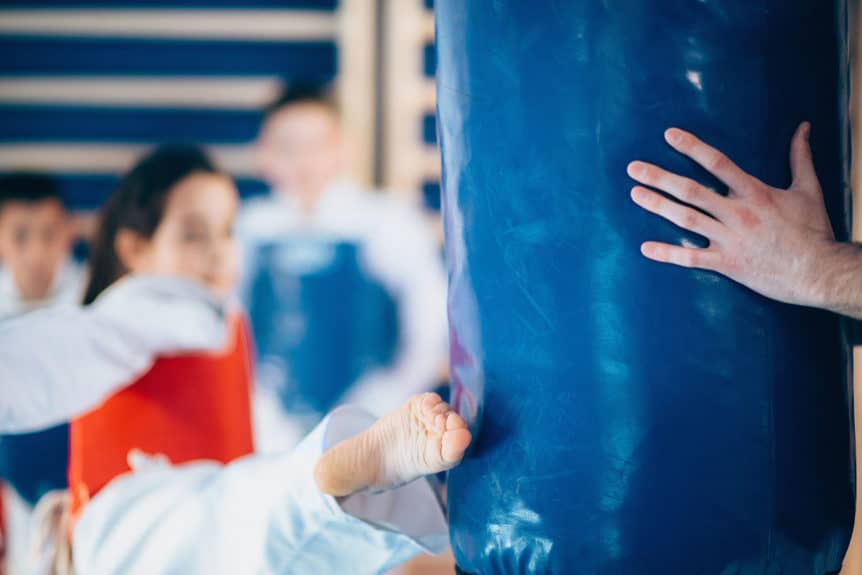

Your first taekwondo class is usually a free or low-cost trial where the instructor teaches you the basics at an easy pace. Wear comfortable workout clothes, bring water, take off jewelry and arrive 10 to 15 minutes early to fill out a waiver. You will train barefoot, bow when you step onto the floor, line up by rank and follow a class that runs from warm-up to basics, kicks, forms and pad work. Nobody expects you to know anything yet. This guide covers what to do before, during and after that first class, for adults and for parents signing up a child.
| What to wear | A T-shirt and track pants or other loose workout clothes; no uniform needed yet |
|---|---|
| What to bring | Water bottle, hair tie, a towel and any forms the school sent you |
| Arrive | 10 to 15 minutes early for the waiver and a quick introduction |
| On the floor | Barefoot, no jewelry or watches, nails trimmed |
| Class flow | Bow-in, warm-up, basics, kicks, forms, pad work, cool-down, bow-out |
| Sparring | Often not on day one; most schools build up to it |
| Before you join | Ask about fees, contracts, testing costs and the class schedule |
Before class
Before your first taekwondo class
Book a trial class
Most schools offer a trial class or a short trial period so you can see the training before you pay for a membership. Call or message the school, ask which class suits a complete beginner and book that one. Some schools run a separate beginner or intro class; others put new students into the regular class and pair them with a senior student. If you are still comparing schools, try a class at two or three before you decide (see how to choose a taekwondo school).
What to wear
You don’t need a uniform for a trial. Wear clothes you can kick and stretch in: a T-shirt and track pants or sweatpants work well. Avoid jeans, very loose shorts, zippers and anything with hard buttons. Tie back long hair. If you already own a uniform from another martial art, ask before you wear it; many schools prefer street workout clothes until you join.
What to bring
- A water bottle. Classes are active and you will sweat (see how to stay hydrated for martial arts).
- Slip-on shoes or sandals for walking to and from the floor, since you will train barefoot.
- A hair tie and a small towel.
- A photo ID and any paperwork the school asked you to fill out ahead of time.
- A short list of questions for the instructor (there is a list below).
Arrive early and sign the waiver
Plan to arrive 10 to 15 minutes before class. Most schools ask new students to sign a liability waiver and a short form with contact details and health information before they step on the floor. For a child, a parent or guardian signs. Read the waiver before you sign it, and use the extra minutes to use the restroom, meet the instructor and tell them about any injuries or health limits so they can adjust drills for you.
Note
This is general information, not medical advice. If you have a heart, joint or other health condition, an injury, or you haven’t exercised in a long time, talk to a doctor before you start, and tell the instructor about any limits before class.
Etiquette
Dojang etiquette for new students
Taekwondo is trained in a dojang (training hall), and every school has rules of conduct. Instructors know you won’t know them yet. Watch the senior students and copy what they do. These are the customs you are most likely to meet on day one; details differ from school to school, and your school’s rules come first.
Gyeongnye
Bowing
Bow when you step onto and off the training floor, to the instructor at the start and end of class, and to a partner before and after a drill. See bowing in taekwondo.
Sabeomnim
Addressing the instructor
Many Kukkiwon schools call the instructor sabeomnim; ITF schools often write it sabum nim. In many US schools, “sir” or “ma’am” is used in class. Ask what your school uses.
Lining up
Lining up by rank
Students line up in rows by belt rank, with the highest ranks in front. As a new white belt, you will usually stand at the back or end of the line.
Barefoot
Shoes off
Take off your shoes and socks before you step onto the floor. Taekwondo is trained barefoot. See why taekwondo is trained barefoot.
Safety
No jewelry
Remove rings, watches, earrings, necklaces and bracelets. They can scratch a partner or catch on a uniform. Ask about anything you can’t take off.
Hygiene
Short nails
Trim your fingernails and toenails before class. Long nails cut training partners and tear on pads.
A few more customs are common. Raise your hand and wait to be called on before you ask a question. If you need to leave the floor, ask the instructor first. If you arrive late, wait at the edge of the floor until the instructor sees you and waves you in, then bow and join the back of the line. And answer instructions out loud: many schools expect a clear “yes, sir” or “yes, ma’am,” or a kihap, the short shout students give with a technique.
| Korean | What it means in class |
|---|---|
| Charyeot (차렷) | Attention: feet together, hands at your sides |
| Gyeongnye (경례) | Bow |
| Junbi (준비) | Ready |
| Sijak (시작) | Begin |
| Baro (바로) | Return to the ready position |
| Sabeomnim (사범님) | Instructor |
| Dojang (도장) | Training hall |
| Dobok (도복) | Uniform |
Spellings follow Kukkiwon and World Taekwondo usage; ITF schools use some different words and older spellings, such as charyot and kyong ye. You don’t need to memorize these before class. For the full list, see taekwondo terminology.
In class
What happens in a typical first class
Classes often run 45 to 60 minutes. Every school runs its own program, but most follow a pattern close to this one.
- Bow-in. The class lines up, comes to attention and bows to the flags and the instructor. Follow the person next to you.
- Warm-up. Light jogging, jumping jacks, joint circles and leg stretches. Go at your own pace; nobody expects you to keep up with black belts (see taekwondo warm-up exercises).
- Basics. Lines of students practice stances, punches and blocks on the instructor’s count, often in Korean. A senior student or assistant may work with you on the side.
- Kicks. Beginners usually start with the front kick and roundhouse kick, kicked slowly in the air before they go near a target.
- Forms. The class practices poomsae (forms in Kukkiwon schools) or tul (patterns in ITF schools). You may learn the first few moves of your first form, or practice the stances it uses.
- Pad work. Partners take turns holding kicking pads. This is often the most fun part of a first class, and it is where you first feel your kicks land.
- Cool-down and bow-out. Stretching, a short talk from the instructor and a closing bow. Some schools recite the student oath or the tenets of taekwondo.
Will you spar? Often not. Most schools don’t put new students into free sparring on the first day. They build up to it over weeks or months, starting with pre-arranged drills and moving to controlled sparring with protective gear. If a school asks a brand-new student to spar hard on day one, that is worth noting when you compare schools.
The techniques themselves, from the first stances to the first form, are covered in taekwondo for beginners: what you learn first.
Afterwards
How you may feel after your first class
It is normal to leave your first class tired, a little sweaty and a bit overwhelmed by new words and movements. Many beginners notice sore legs, hips and core muscles a day or two later, especially if they haven’t kicked before. Hamstrings and hip flexors often feel it most. That kind of muscle soreness usually eases within a few days and gets milder as your body adapts.
You may also feel clumsy. Balance on one leg, remembering which foot goes forward and following Korean counts all take time. That feeling fades with every class. Two classes a week is a common starting schedule.
Note
This is general information, not medical advice. Ordinary muscle soreness feels dull and spreads over a muscle. Sharp pain, pain in a joint, swelling, or pain that gets worse instead of better is different: rest, skip the next class and see a doctor if it doesn’t improve (see common taekwondo injuries).
Ask
Questions to ask the instructor
The end of a trial class is a good time to ask. A good school answers these questions clearly and without pressure.
- Which organization is the school affiliated with? Kukkiwon and World Taekwondo, the ITF, the ATA or an independent group. It affects the forms, the belt order and the rank certificates you earn.
- Who teaches the beginner classes, and what rank and teaching experience do they have?
- How many classes a week can you attend, and is there a separate beginner class?
- How much is the monthly fee, and what does it include?
- How often are belt tests, and what do they cost? Ask about the first one in particular (see the taekwondo belt order).
- What gear will you need, and when? A uniform first; sparring gear later.
- When does sparring start, and how is contact controlled for beginners?
- Is there a contract, how long is it, and how do you cancel?
- Can parents watch, and is there a family discount?
For typical price ranges, see how much taekwondo lessons cost.
Kids vs. adults
Notes for parents and for adult beginners
| Kids’ first class | Adult’s first class | |
|---|---|---|
| Class style | Often more games, short drills and lots of praise | More explanation of why a technique works |
| Paperwork | A parent or guardian signs the waiver | You sign your own waiver |
| Watching | Many schools have a viewing area for parents | Usually no audience; some schools allow a guest |
| Common worry | Shyness, or not wanting to join in | Fitness, flexibility or feeling out of place |
| Best approach | Let the instructor lead; cheer quietly from the side | Train at your own pace and tell the instructor your limits |
For parents
Talk to your child before class about what will happen: bowing, bare feet, lining up and listening to the instructor. Arrive early so they can see the room before it fills up. Once class starts, let the instructor take charge. Calling out tips from the side can confuse a child who is trying to follow the instructor. If your child is shy, many instructors will let them watch for a few minutes before joining in. After class, ask what they liked rather than what they got wrong. For age guidance, see the best age for kids to start taekwondo.
For adult beginners
Many schools run adult or family classes, and starting from zero is normal. Don’t try to match the kicking height of students who have trained for years; low, controlled kicks are the right place to start. Tell the instructor about old injuries, take a water break when you need one and judge the school on how it treats beginners, not on how hard the first class felt. More on starting later in life in taekwondo for adults.
After class
After your first class: uniforms and contracts
Buying a uniform
If you join, you will need a uniform (dobok) and a white belt. Many schools sell their own uniform with the school patch, and some include the first one in a sign-up package. Ask before you buy one online: some schools require a specific style, such as a V-neck dobok in Kukkiwon schools or an ITF-approved uniform. If you do buy your own, get the size chart and leave a little room for shrinking. See how to buy a taekwondo uniform and how to tie a taekwondo belt.
Read the contract before you sign
Some schools charge month to month. Others ask for a contract of six months, a year or longer, sometimes with a discount for paying up front. Take the paperwork home and read it before you sign. Look for:
- Length and total cost of the contract, not only the monthly fee.
- Extra fees: registration, belt tests, black belt programs, required gear and tournament entry.
- Cancellation terms: how to cancel, how much notice you must give and what you owe if you stop early.
- What happens if you move or get injured, and if you can freeze the membership.
- Automatic renewal and how payments are taken.
Note
This is general information, not legal advice. Contract terms and consumer rules differ by school, state and country. If a contract is unclear or you are pressured to sign the same day, take it home, ask questions in writing and get advice before you commit.
Checklist
First taekwondo class checklist
- Book a trial class and ask which class is best for a beginner.
- Fill out any forms the school sends ahead of time.
- Trim your fingernails and toenails.
- Pack a water bottle, a towel, a hair tie and slip-on shoes.
- Wear a T-shirt and track pants or other loose workout clothes.
- Leave jewelry and your watch at home.
- Eat a light snack an hour or two before class, not a big meal.
- Arrive 10 to 15 minutes early to sign the waiver.
- Tell the instructor about any injuries or health limits.
- Take off your shoes and bow as you step onto the floor.
- Line up at the back and copy the senior students.
- Ask your questions about fees, tests and contracts after class.
FAQ
Frequently asked questions
What should I wear to my first taekwondo class?
Loose workout clothes such as a T-shirt and track pants. You don’t need a uniform for a trial class. You will train barefoot, so bring slip-on shoes, and leave jewelry and your watch at home.
What happens in a first taekwondo class?
Most classes start with a bow and a warm-up, then move through basics such as stances, punches and blocks, a few beginner kicks, part of a form and pad work, and finish with stretching and a closing bow. Classes often run 45 to 60 minutes.
Do you spar in your first taekwondo class?
Often not. Most schools build up to sparring over weeks or months, starting with pre-arranged drills and moving to controlled sparring with protective gear.
How early should I arrive for my first class?
Plan to arrive 10 to 15 minutes early. That gives you time to sign the waiver, change, meet the instructor and tell them about any injuries or health limits.
What do you call a taekwondo instructor?
Many Kukkiwon schools use sabeomnim, which means instructor, and ITF schools often write it sabum nim. Many US schools use sir or ma’am in class. Ask what your school uses.
Is it normal to be sore after a first taekwondo class?
Yes. Many beginners feel sore legs, hips and core muscles a day or two later. Ordinary soreness usually eases within a few days. Sharp or joint pain, swelling or pain that gets worse is different and is a reason to rest and see a doctor.
Should I sign a contract after my first class?
Not on the spot. Take the paperwork home and check the length, the total cost, extra fees such as belt tests, the cancellation terms and any automatic renewal before you sign.
More common questions are answered in the taekwondo FAQ.
The short version
Book a trial, wear loose workout clothes, bring water, trim your nails, leave jewelry at home and arrive 10 to 15 minutes early to sign the waiver. On the floor, go barefoot, bow, line up at the back and copy the senior students through warm-up, basics, kicks, forms and pad work. Expect sore legs the next day. Before you join, ask about fees, tests and gear, and read any contract at home before you sign.