
The World Taekwondo Championships is the sport’s biggest event outside the Olympic Games: a senior sparring (kyorugi) tournament run by World Taekwondo every two years. The first edition was held in Seoul in 1973, women’s events were added in 1987, and the championships now feature eight weight categories for men and eight for women. South Korea has won by far the most titles. The 2025 edition was held in Wuxi, China, and the next is scheduled for Astana, Kazakhstan, in 2027. This guide covers its history, format, weight classes, sparring rules and how it compares with the Olympics.
| Organizer | World Taekwondo (formerly the World Taekwondo Federation) |
|---|---|
| First held | 1973, Seoul, South Korea |
| How often | Every two years |
| Events | Senior kyorugi (sparring): 8 men’s and 8 women’s weight categories |
| Most successful nation | South Korea |
| Latest and next | 2025 Wuxi, China; next 2027 Astana, Kazakhstan |
History
History of the World Taekwondo Championships
World Taekwondo was founded in Seoul in 1973 (as the World Taekwondo Federation), and the first World Taekwondo Championships took place there the same year. The event was held in Seoul again in 1975, then moved around the globe, including Chicago in 1977. Women’s events were introduced at the 1987 championships in Barcelona. The championships are normally held every two years; the planned 2021 edition was postponed during the COVID-19 pandemic and held in Guadalajara, Mexico, in 2022.
Over the years the event changed with the sport: protective gear became standard, electronic protector and scoring systems (PSS) replaced judges scoring kicks by eye, and the rules were updated to reward head kicks and turning kicks. Taekwondo’s place in the Olympics, as a demonstration sport in 1988 and a full medal sport since Sydney 2000, also raised the profile of the World Championships. See taekwondo and the Olympic Games.
| Year | Host |
|---|---|
| 1973 | Seoul, South Korea (first edition) |
| 1987 | Barcelona, Spain (first women’s events) |
| 2017 | Muju, South Korea |
| 2019 | Manchester, United Kingdom |
| 2022 | Guadalajara, Mexico |
| 2023 | Baku, Azerbaijan |
| 2025 | Wuxi, China |
| 2027 | Astana, Kazakhstan (scheduled) |
Weight classes
World Championships weight categories
The World Championships use eight weight categories per gender, double the four used at the Olympics, so more athletes can compete near their natural weight.
| Men | Women |
|---|---|
| -54 kg (fin) | -46 kg (fin) |
| -58 kg (fly) | -49 kg (fly) |
| -63 kg (bantam) | -53 kg (bantam) |
| -68 kg (feather) | -57 kg (feather) |
| -74 kg (light) | -62 kg (light) |
| -80 kg (welter) | -67 kg (welter) |
| -87 kg (middle) | -73 kg (middle) |
| +87 kg (heavy) | +73 kg (heavy) |
Sparring
How sparring works at the World Championships
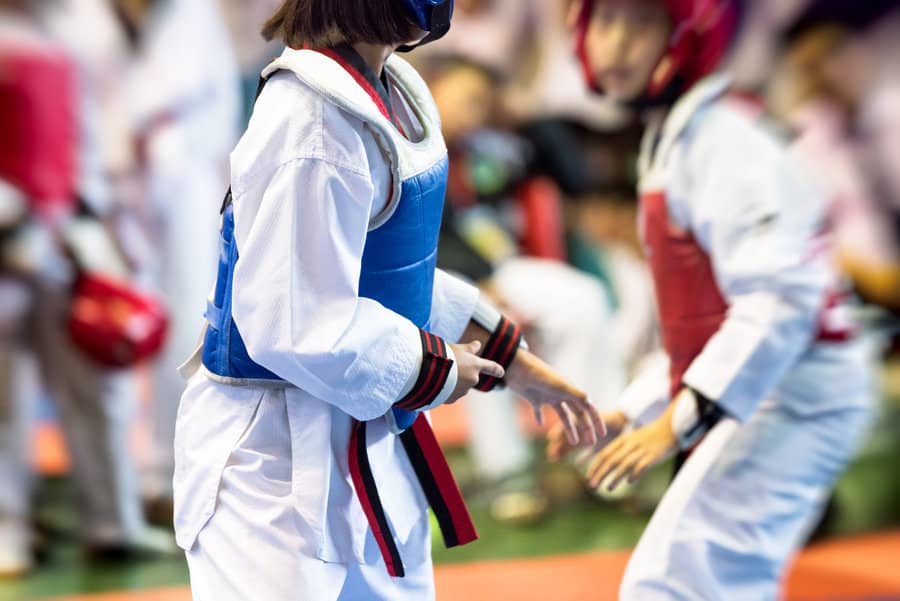
Matches follow the World Taekwondo competition rules, the same rules used at the Olympics. Athletes wear electronic trunk and head protectors and sensor socks, and kicks are scored automatically.
- Format: single-elimination brackets in each weight category, with two bronze medals.
- Rounds: best-of-three rounds of two minutes; win two rounds to win the match.
- Scoring: 1 point for a punch to the trunk, 2 for a kick to the trunk, 3 for a kick to the head, with extra points for turning kicks; each penalty (gam-jeom) gives the opponent a point.
- Officials: a referee controls the match, judges score punches, and video replay can review certain calls.
See taekwondo sparring rules, the role of the referee and sparring tips.
Compared
World Championships vs the Olympics
| World Championships | Olympic Games | |
|---|---|---|
| How often | Every 2 years | Every 4 years |
| Weight categories | 8 per gender | 4 per gender |
| Entries | National federations enter their own athletes | Limited places earned through rankings and qualifiers |
| Rules | World Taekwondo competition rules | World Taekwondo competition rules |
Because there are more weight classes and fewer entry limits, the World Championships usually have more athletes and countries than the Olympic taekwondo event. Results also count toward World Taekwondo’s world rankings, which feed into Olympic qualification.
Other events
Other World Taekwondo and ITF championships
- World Poomsae Championships: forms competition, held separately from the sparring championships.
- World Para Taekwondo Championships: for athletes with impairments, first held in 2009. See para taekwondo.
- World Junior and Cadet Championships: for younger athletes. See taekwondo and the Junior Olympics.
- Grand Prix series: regular ranking events for the top-ranked athletes.
- ITF World Championships: the International Taekwon-Do Federation runs its own world championships under ITF rules. See taekwondo styles.
If you want to start competing, see how to prepare for a tournament and sparring combinations.
FAQ
Frequently asked questions
How often are the World Taekwondo Championships held?
Every two years. The 2021 edition was moved to 2022 because of the COVID-19 pandemic, and the cycle continued with 2023 and 2025.
When was the first World Taekwondo Championships?
In 1973 in Seoul, South Korea, the same year World Taekwondo (then the World Taekwondo Federation) was founded. Women’s events were added in 1987.
Where is the next World Taekwondo Championships?
The next edition is scheduled for Astana, Kazakhstan, in 2027. The 2025 championships were held in Wuxi, China.
Which country has won the most World Taekwondo Championships medals?
South Korea, by a wide margin. Spain and Turkey are next on the all-time gold medal table.
How many weight classes are there at the World Taekwondo Championships?
Sixteen: eight for men and eight for women, compared with four per gender at the Olympics.
Is the World Taekwondo Championships the same as the Olympics?
No. Both use World Taekwondo rules, but the World Championships are held every two years with eight weight classes per gender, while the Olympics are every four years with four.
The short version
The World Taekwondo Championships is World Taekwondo’s senior sparring championship, held every two years since 1973, with eight weight classes per gender and Olympic-style rules. South Korea leads the all-time table. The 2025 edition was in Wuxi, China, and the next is planned for Astana, Kazakhstan, in 2027.